
Making Sense of Seal Flush Plans
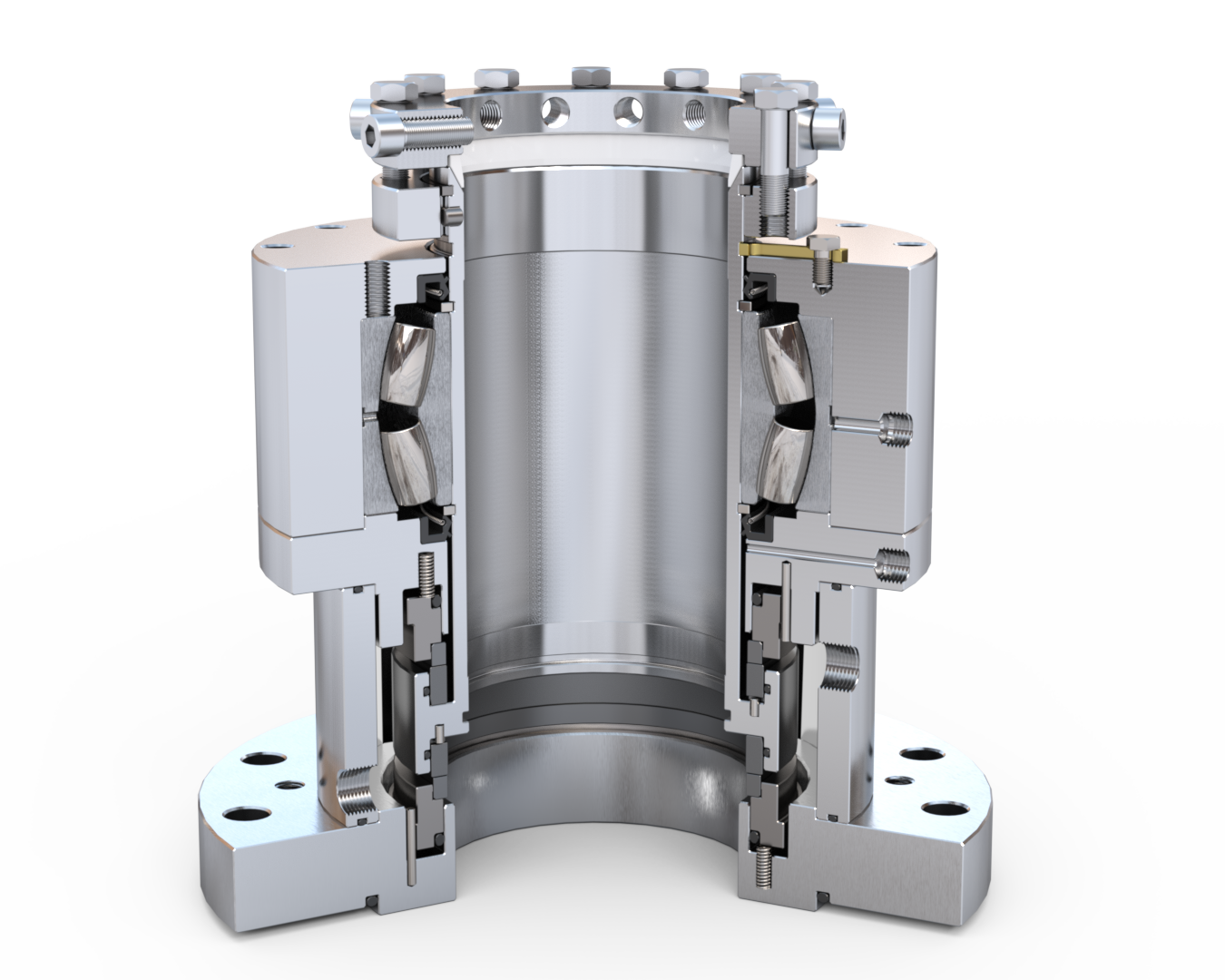
If you work with mechanical seals in oil & gas, chemical, power, or process industries, you have almost certainly heard of API 682 Seal Plans. These plans define how fluid is supplied to the seal to keep it cool, clean, and properly lubricated.
Unfortunately, many engineers and technicians find API 682 plans confusing because of the technical language and numbering system.
A maintenance supervisor once told us: “We were using the wrong flush plan for years without realizing it. Once we understood what each plan actually does and switched to the correct one, our seal life improved significantly.”
At Orbit Fluid Solution LLP, we believe these standards should be easy to understand. In this guide, we explain API 682 Seal Plans in simple language, so you can select and apply them with confidence.
What is API 682?
API 682 is a standard developed by the American Petroleum Institute. It provides guidelines for the design, selection, and application of mechanical seals and their support systems in the petroleum, natural gas, and chemical industries.
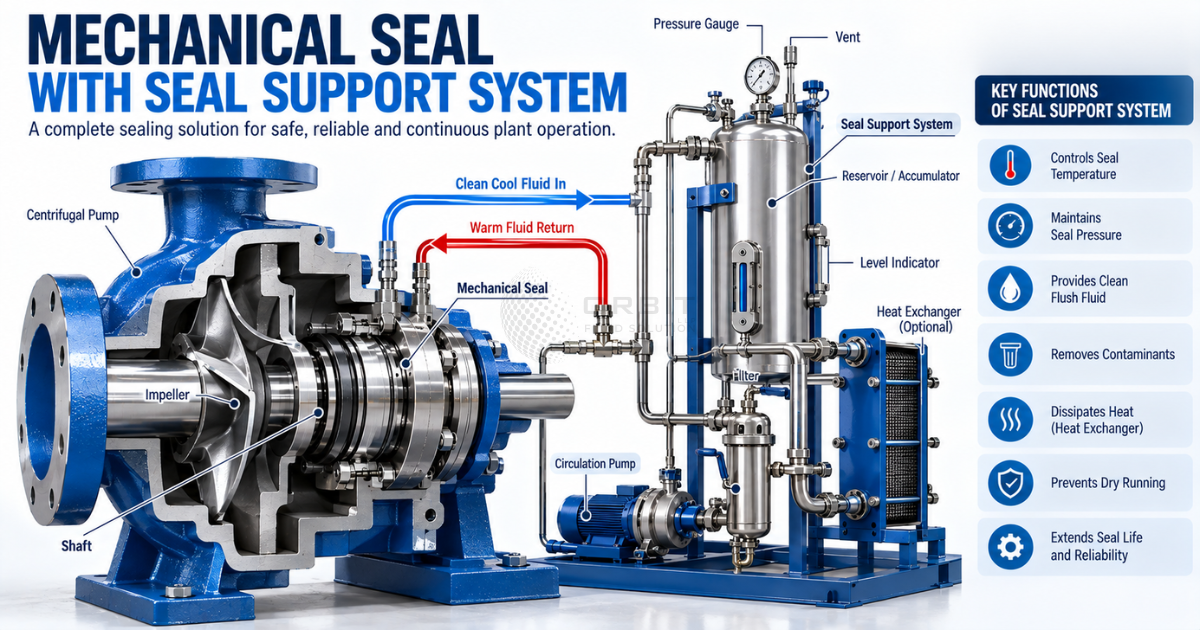
One of the most practical parts of API 682 is the Seal Support System Plans (commonly called Seal Plans or Flush Plans). These plans describe different piping arrangements that supply fluid to the mechanical seal.
Why Seal Plans Are So Important
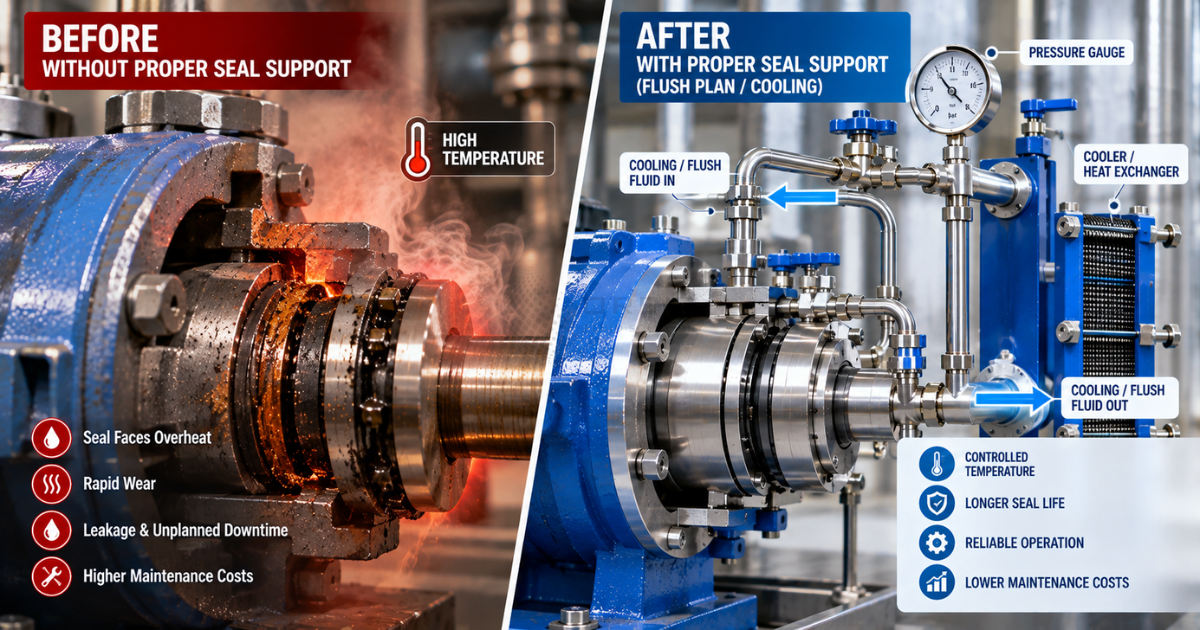
The seal faces generate heat due to friction. They also need a clean lubricating film to work properly. Without the right support system:
- Faces can overheat and crack
- Abrasive particles can destroy the faces
- The seal can run dry
- Seal life can drop dramatically
The correct API plan helps control temperature, keep faces clean, and maintain the lubricating film.
Most Common API 682 Seal Plans Explained Simply
Here are the plans you will encounter most often, explained in plain language:
Plan 11 – Default Internal Recirculation
What it does: Takes fluid from the pump discharge and injects it into the seal chamber.
Best for: Clean fluids with moderate temperature.
Simple view: The most basic and widely used plan.
Plan 13 – Recirculation to Suction
What it does: Takes fluid from the seal chamber and returns it to the pump suction.
Best for: Vertical pumps and some clean services.
Simple view: Helps reduce pressure in the seal chamber.
Plan 21 – Cooled Internal Recirculation
What it does: Same as Plan 11, but the fluid passes through a cooler before entering the seal chamber.
Best for: Hot applications where cooling is required.
Simple view: Plan 11 + cooler.
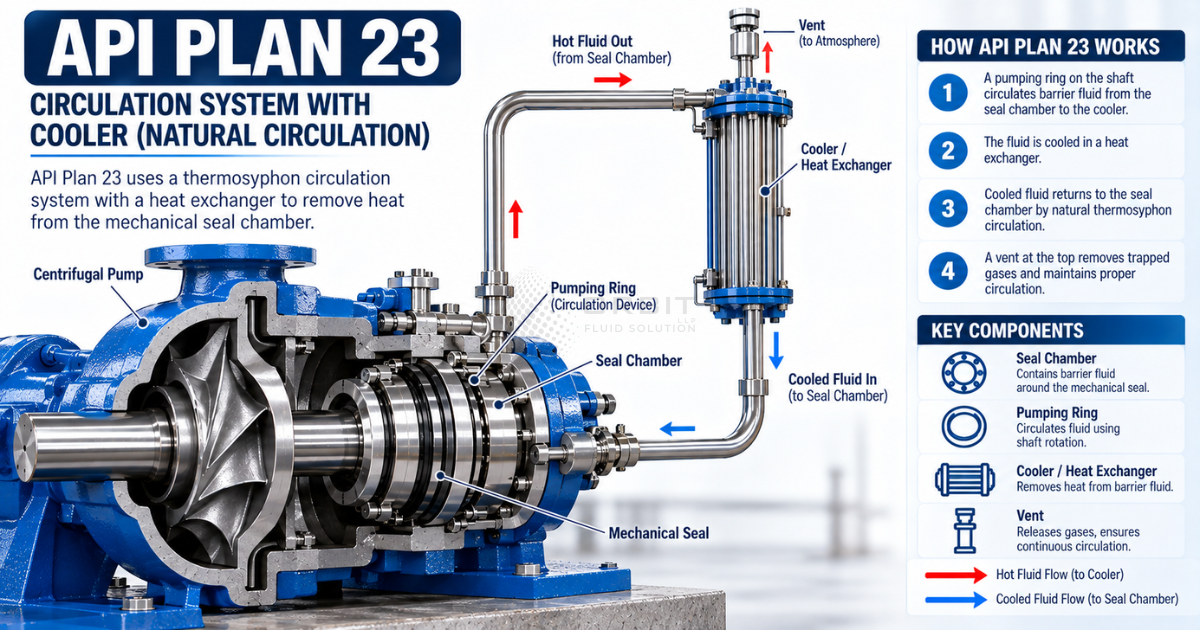
Plan 23 – Cooled Closed-Loop Circulation
What it does: Fluid is circulated from the seal chamber through a cooler and back using a pumping ring.
Best for: Hot water and boiler feed applications.
Simple view: Self-contained cooling circuit for the seal.
Plan 31 – Cyclone Separator
What it does: Uses a cyclone separator to remove solids from the flush fluid before it goes to the seal.
Best for: Fluids with moderate solids.
Simple view: Plan 11 with a solids separator.
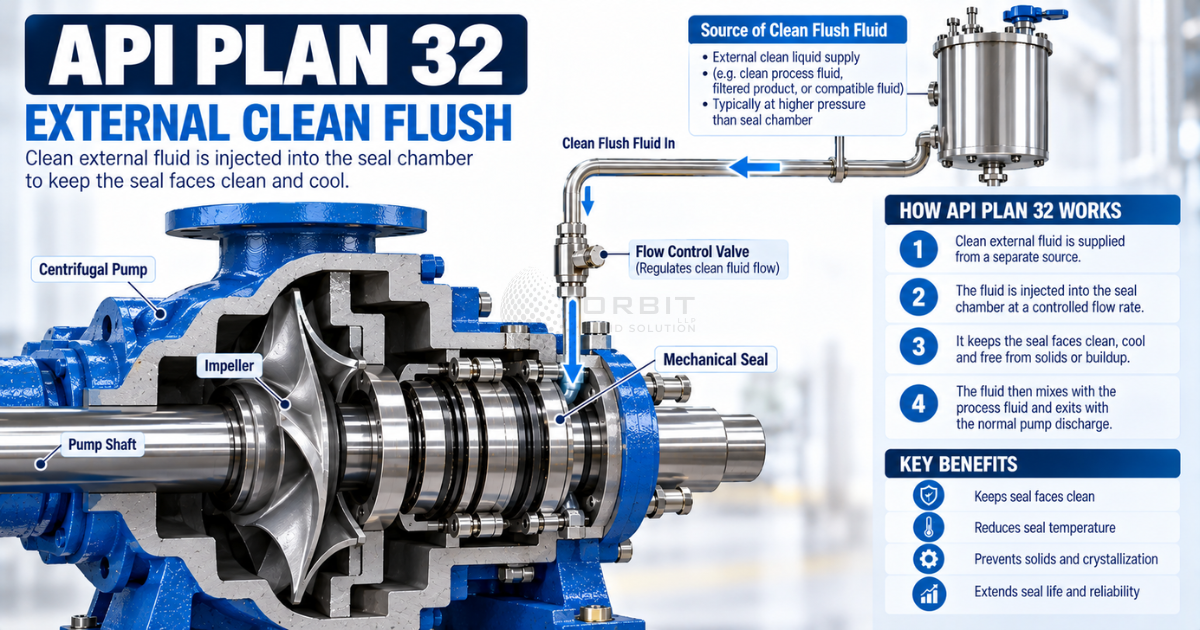
Plan 32 – External Clean Flush
What it does: Injects clean external fluid (usually clean water or compatible liquid) into the seal chamber.
Best for: Abrasive, dirty, or polymerizing fluids.
Simple view: One of the most effective plans for slurry and dirty services.
Plan 41 – Combination of Cooler and Separator
What it does: Combines cooling and solid separation.
Best for: Hot fluids that also contain solids.
Dual Seal Plans (Barrier and Buffer Systems)
When double mechanical seals are used, special plans manage the fluid between the two seals.
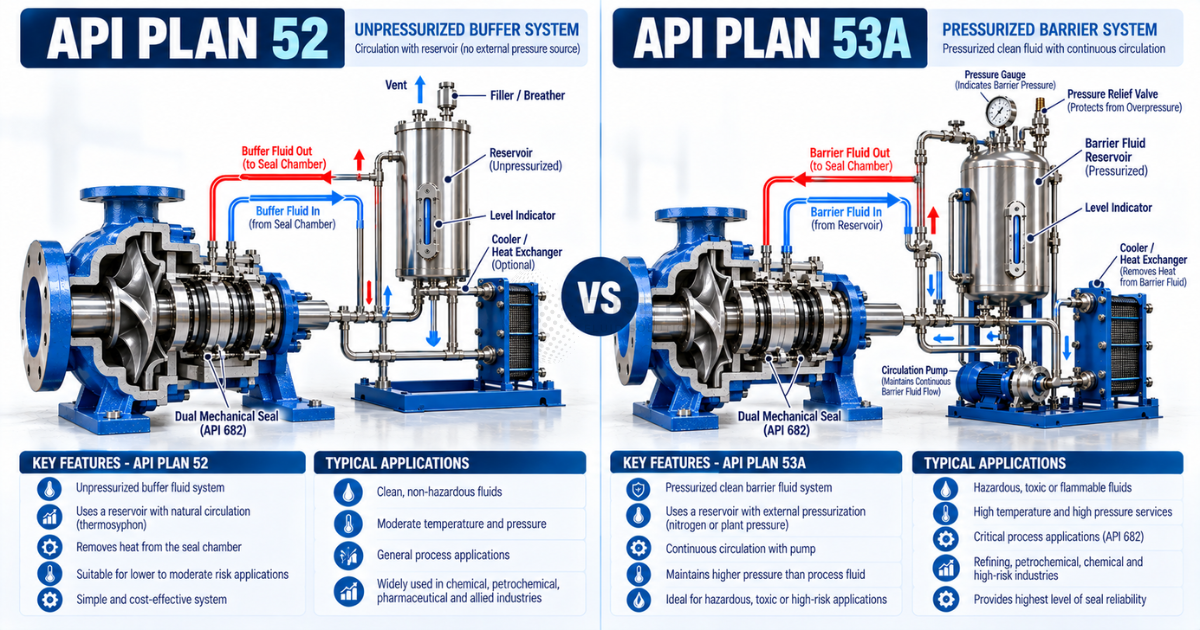
Plan 52 – Unpressurized Buffer System
What it does: Provides an unpressurized buffer fluid between the seals.
Best for: Tandem seal arrangements where process fluid is not highly hazardous.
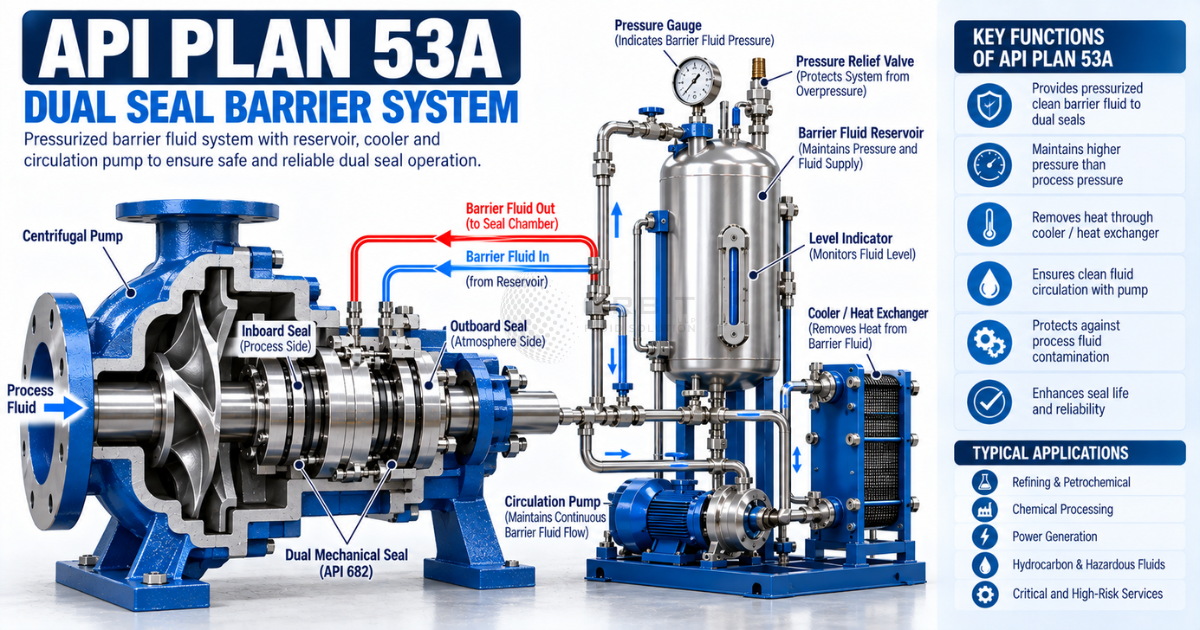
Plan 53A – Pressurized Barrier System with Reservoir
What it does: Uses a pressurized reservoir to keep barrier fluid at higher pressure than the process.
Best for: Hazardous fluids that must not leak to atmosphere.
Simple view: Most common pressurized dual seal plan.
Plan 53B – Pressurized System with Bladder Accumulator
What it does: Similar to 53A but uses a bladder accumulator instead of a simple reservoir.
Best for: Applications needing more stable pressure control.
Plan 53C – Pressurized System with Piston Accumulator
What it does: Uses a piston-type accumulator driven by process pressure.
Best for: Specific high-reliability dual seal applications.
Plan 54 – External Pressurized Barrier System
What it does: Barrier fluid is supplied and circulated by an external system.
Best for: Multiple seals or centralized barrier fluid systems.
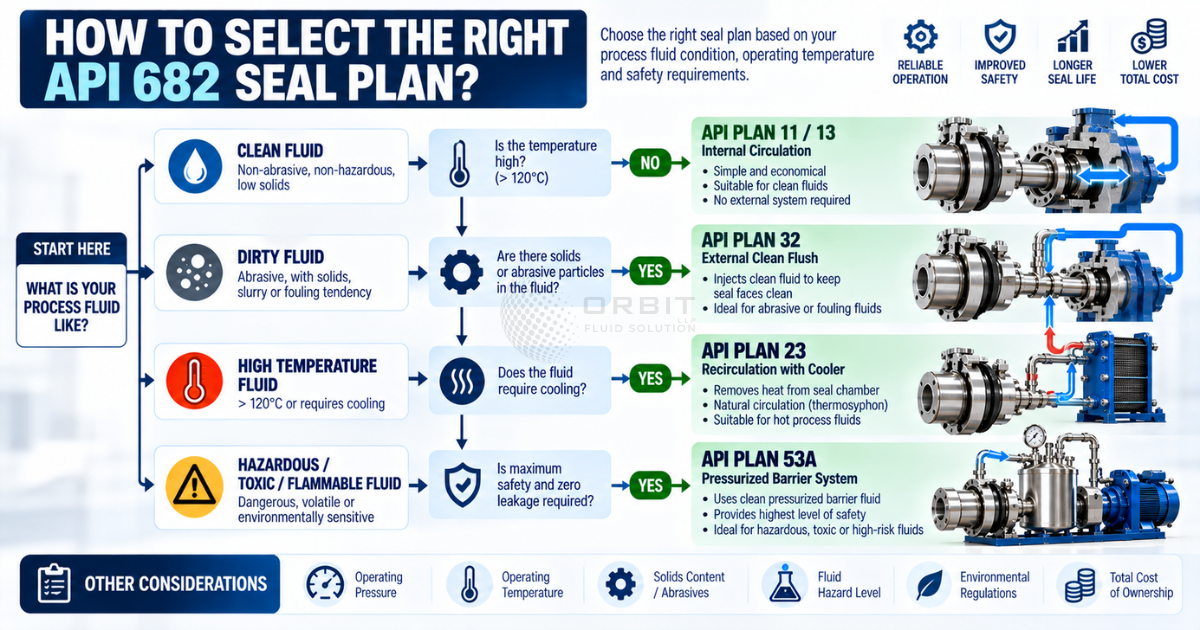
How to Choose the Right Seal Plan
Ask these practical questions:
- Is the process fluid clean or dirty/abrasive?
- Is the fluid hot?
- Is the fluid hazardous or toxic?
- Are you using a single seal or double seal?
- Is cooling required?
- Is solid separation needed?
Quick Guidance:
- Clean + moderate temperature → Plan 11 or 13
- Hot + clean → Plan 21 or 23
- Dirty or abrasive → Plan 32 (very common)
- Hazardous fluid → Dual seal with Plan 53A/B/C or 54
Common Mistakes with Seal Plans
- Using Plan 11 on hot applications without cooling
- Applying Plan 32 without controlling flush flow rate
- Installing dual seals without a proper barrier system
- Ignoring cooler or filter maintenance
- Selecting a plan based only on habit instead of actual conditions
Improving Seal Life with the Correct Plan
A process plant was using Plan 11 on a hot water application and experiencing frequent seal failures due to overheating. After evaluation by Orbit Fluid Solution LLP, the system was changed to Plan 23.
Results:
- Seal chamber temperature dropped significantly
- Seal life increased from a few months to over 18 months
- Unplanned failures were greatly reduced
This case shows how selecting the correct API plan can dramatically improve reliability.
Best Practices for Seal Plans
- Always match the plan to the real operating conditions
- Keep coolers, filters, and strainers clean and functional
- Monitor flush flow and pressure
- For dual seals, regularly check barrier fluid level and pressure
- Document which plan is used on each pump
- Train technicians on the purpose of each plan
How Orbit Fluid Solution LLP Helps with Seal Plans
At Orbit Fluid Solution LLP, we help customers select and implement the right API 682 seal plans by:
- Analyzing process conditions
- Recommending the most suitable plan
- Supplying seals designed to work with proper support systems
- Guiding installation and commissioning of flush/barrier systems
- Supporting troubleshooting when plans are not performing
Our goal is to make these standards practical and effective for your plant.
Simple Understanding Leads to Better Reliability
API 682 Seal Plans do not have to be complicated. When explained in simple language, they become powerful tools for improving mechanical seal life and reliability.
The key is to understand what each plan actually does and match it to your fluid, temperature, and risk level. The right plan keeps the seal faces cool, clean, and properly lubricated — which is exactly what a mechanical seal needs to last.
At Orbit Fluid Solution LLP, we help engineers and maintenance teams apply these plans correctly for real-world results.
Need help selecting or troubleshooting an API 682 seal plan? Contact our technical team today for practical, application-specific support.
8. Poor Quality Components or Incompatible Materials
Not all seals are manufactured to the same standard. Low-quality faces, springs, or elastomers, or materials incompatible with the process fluid, lead to early failure.
How to prevent it:
- Source seals from reputable manufacturers
- Verify material certificates when required
- Match elastomer and face materials to the process chemical and temperature
- Avoid choosing seals based only on the lowest price
How Orbit Fluid Solution LLP Helps Prevent Premature Failures
At Orbit Fluid Solution LLP, we support plants in reducing premature seal failures through:
- Application engineering and correct seal selection
- High-quality cartridge and engineered seals
- Guidance on flush plans and materials
- Installation training and troubleshooting support
- Failure analysis to identify root causes
Our goal is to help you move from frequent replacements to long-term reliability.
Also Read:
-
 Top 10 Causes of Mechanical Seal Leaks and How to Fix Them16 Apr 2025 Seal Failure and Prevention
 -
 The Ultimate Guide to Choosing Mechanical Seals for the Food Processing Industry05 Apr 2025 Industry-Specific Seal Solutions
 -
 How to Prevent Seal Failures in Oil and Gas Applications: A Comprehensive Guide16 Apr 2025 Industry-Specific Seal Solutions
 -
API 682 Seal Plans Explained in Simple Language05 Oct 2026 Industry-Specific Seal Solutions
-
 Top 8 Reasons Why Mechanical Seals Fail Prematurely28 Sep 2026 Industry-Specific Seal Solutions

